New to the knife and worried about your fingers? Here’s how to chop an onion: halve it, keep the root on, slice in a grid, and tuck your fingertips into a claw.
Knife basics are one of the first skills in our guide to cooking tips for beginners.
| Item | Value |
|---|---|
| Spacing between cuts for chopped or diced onion | 1/4 to 1/2 inch |
| Spacing between cuts for minced or finely chopped onion | 1/8 to 1/4 inch |
| Minced pieces | 1/8 inch or smaller |
| Uncut onion left at the root end | About a half inch |
| Horizontal slices before the vertical cuts | Two slices |
These figures come from America’s Test Kitchen and Virginia Cooperative Extension. Guidance can change, so check the sources before you rely on the figures.
What do you need before you start?
You need a sharp chef’s knife, a cutting board and clean hands, and nothing here requires buying anything new. Virginia Cooperative Extension advises working in a clean area with clean tools and washing your hands before you begin.
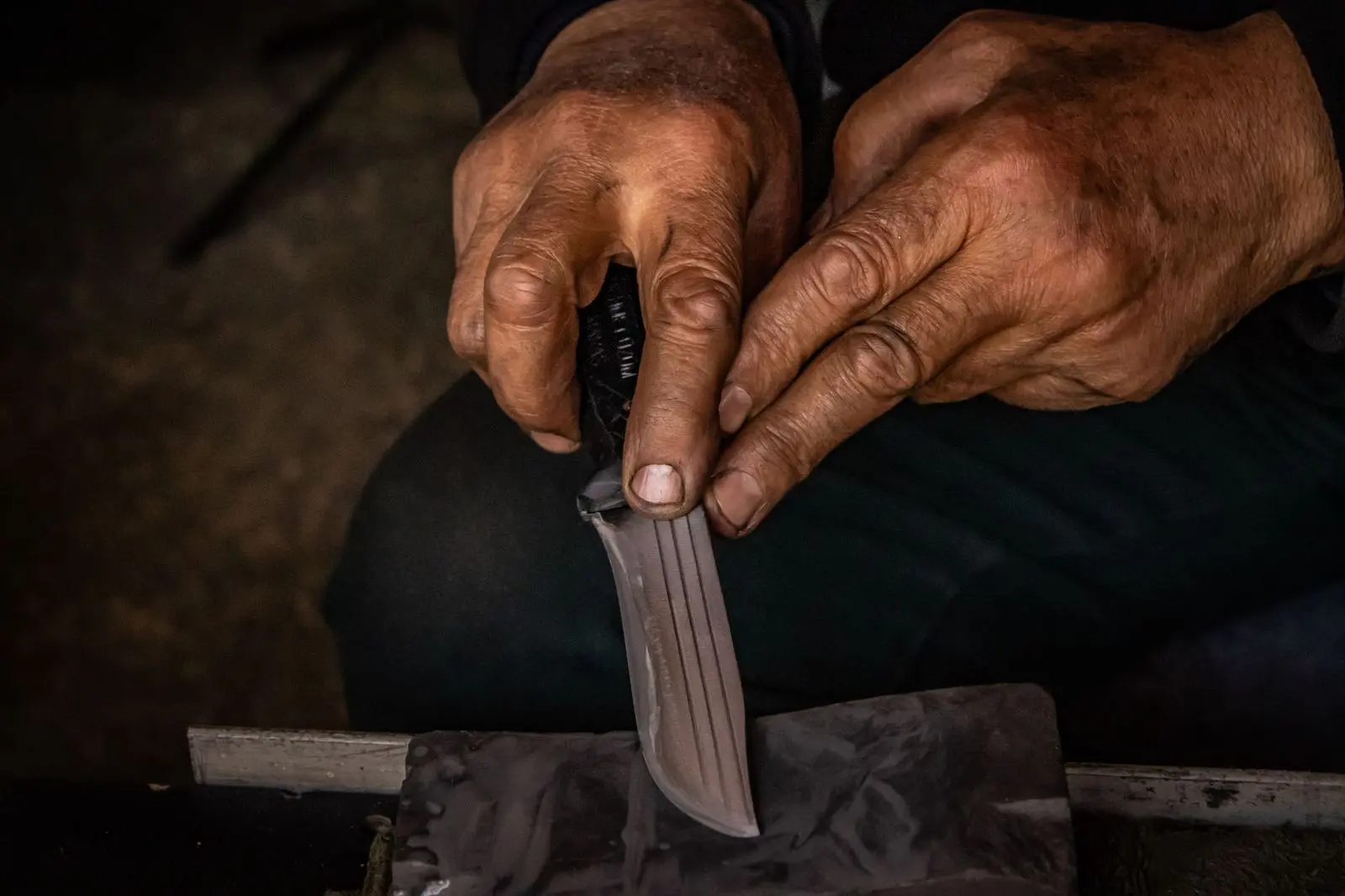
A dull blade slips, which is why America’s Test Kitchen calls a sharp knife a fast knife and a dull one an accident waiting to happen. The same page suggests choking up on the handle, with your thumb and index finger gripping the heel of the blade, for the most control.
Size matters too. Chef Bill Kim, quoted by Tasting Table, suggests 10 to 11 inches is ideal for most people. A knife that is too big feels unwieldy and inaccurate, and the right pick depends on your height, hand size and comfort level.
Virginia Cooperative Extension’s safety rules for knife work are short:
- Hold the onion with a claw grip, curling your fingers in so they stay out of the blade’s way.
- Carry the knife with its tip pointed toward the floor, and never point it at anyone.
- Never try to catch a falling knife.
- Keep your thumb and pinky finger tucked behind the other fingers of the guiding hand.
If tonight’s dinner also starts with meat from the freezer, our guide on how to thaw frozen meat safely covers that part.
How to chop an onion, step by step
This is the grid method. It works the same on a small onion or a large one, and it is the approach both extension and test-kitchen sources teach.
- Halve it. Cut the onion in half from the top through the root end. Peel off the papery layers until no brown is left, and trim the top. The skin comes off more easily after the onion is cut.
- Slice horizontally. Lay the half flat side down and rest your flat hand on top. Rock the knife in to make two horizontal slices toward the root, without cutting through it.
- Slice vertically. Make several cuts from top to bottom, running up to the root but not through it.
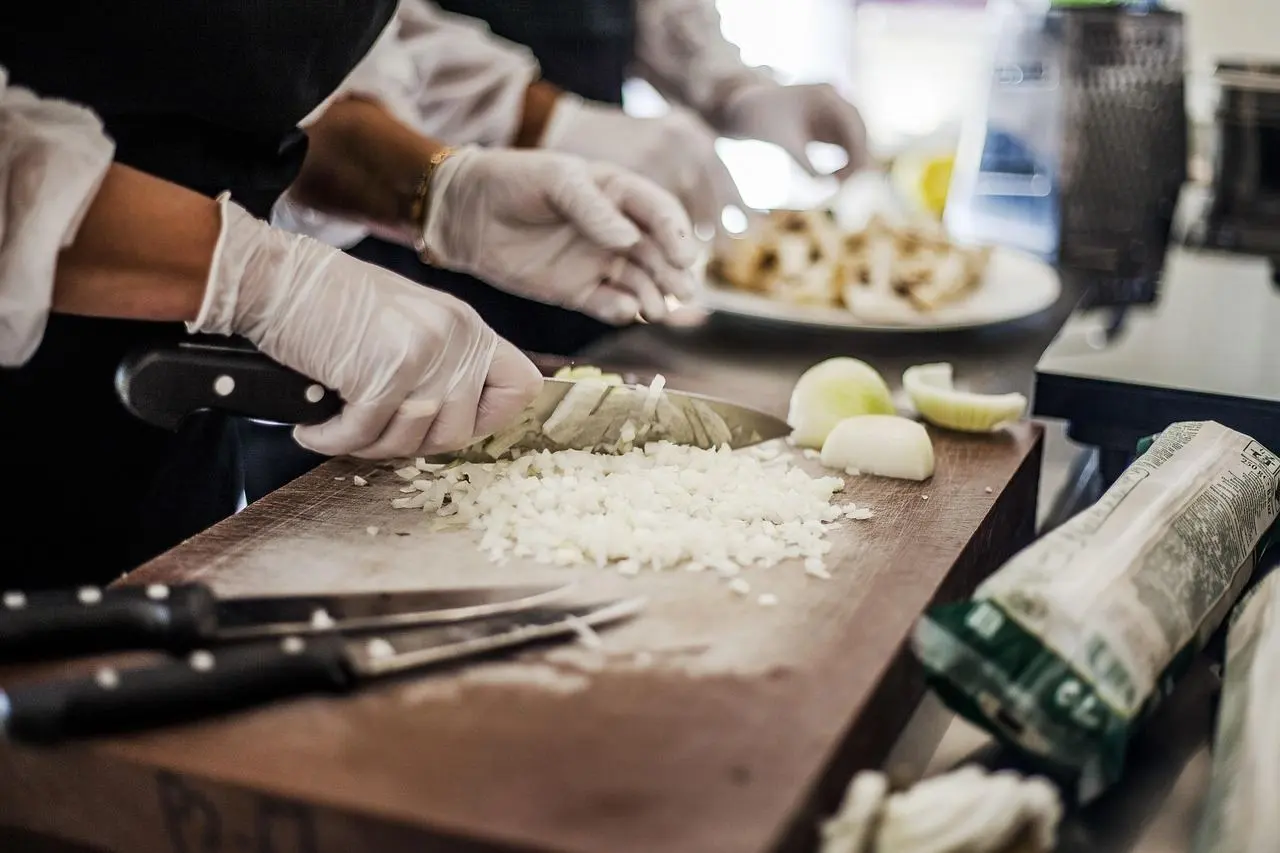
- Cut across. Rotate the half so the root faces away from you, then slice thin across your earlier cuts. Let your knuckles guide the blade while your fingertips hold the onion.
- Finish up. Chop any larger pieces that were left uncut.
Keep the root end attached and leave about a half inch of uncut onion there, as Virginia Cooperative Extension describes, so the half stays in one piece while you work.
Piece sizes for chopped, diced and minced onion
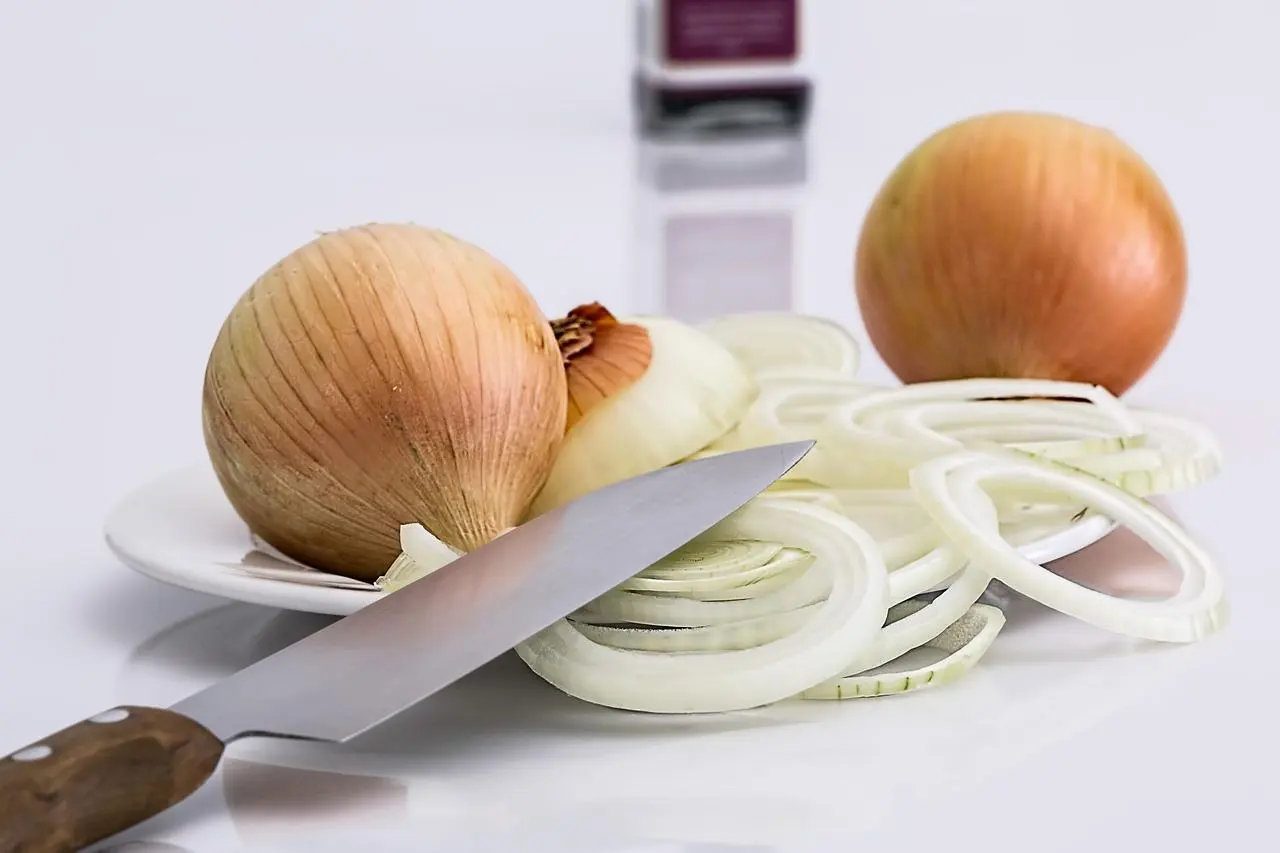
Even pieces cook at the same pace. Chowhound adds that properly diced onions avoid overly onion-y bites and help the flavors of a soup, stir-fry or salsa blend together.
The spacing of your cuts in steps two through four sets the final size. For chopped or diced onions, leave 1/4 to 1/2 inch between cuts, and for finer work, leave 1/8 to 1/4 inch.
| Term | Piece size |
|---|---|
| Minced | 1/8 inch or smaller |
| Chopped fine | 1/8 to 1/4 inch |
| Chopped medium | 1/4 to 1/2 inch |
| Chopped coarse | 1/2 to 3/4 inch |
These size definitions come from America’s Test Kitchen; recipes may define the terms differently, so follow the recipe if it gives its own size.
Other ways to cut an onion
The grid is not the only route. Three variations are worth knowing:
- Rings: trim 1/4 inch from one curved side to make a flat surface, set the onion cut side down and slice, as America’s Test Kitchen explains.
- Radial dice: chefs Ignacio Mattos and David Tanis demonstrated a style where you cut off the root, slice along the grain, push the slices down and cut at a 45 degree angle, according to Tasting Table.
- Upright dice: slice off the top where the peel converges, stand the onion on that flat base and cut vertical slices all around, then lay it on its side for horizontal cuts, as Chowhound describes.
Beginners usually find the grid easiest to control, because the attached root holds everything steady.
How do you chop faster without cutting yourself?
Speed comes from repetition, not from rushing. These habits build it safely:
- Go slowly at first, until you have control of the food and the knife, as Virginia Cooperative Extension recommends.
- Use a rocking motion: push the knife forward as you lower it, and keep the tip on the board.
- Rest the blade against your knuckles in the claw so your fingertips never lead the cut.
- Work from the middle of the blade. Chef Kim says in Tasting Table that the tip positions the knife while the middle does the real work.
Chopping onions ahead fits naturally into a routine like the one in our guide on how to meal prep for the week.
Frequently asked questions
Should I cut off the root before chopping?
Show answer
Many chefs remove both ends first, yet America’s Test Kitchen finds that home cooks have an easier time when the root stays attached, because it holds the layers together through every cut.
Which part of the knife should do the cutting?
Show answer
Use the heel of the blade when you need extra force, and chop with food flat side down, says Virginia Cooperative Extension.
How can I stop my eyes from watering?
Show answer
Chilling the onion in the freezer first, or running your stove’s vent hood while you cut, are the two approaches listed by Chowhound.
Does it matter if my pieces are uneven?
Show answer
A little unevenness is fine while you practise. The aim, per America’s Test Kitchen, is pieces of similar size so that they finish cooking together.
What is the difference between dicing and mincing?
Show answer
Dicing makes small cube-shaped pieces, while mincing makes the smallest pieces possible, according to the vocabulary list from Virginia Cooperative Extension.